Saturday, July 17, 2010

Struggle To The Sea II

Each hatchling faces a major hurdle just getting from the nest to the ocean. During their travels for the next 30 years before returning to our beaches to lay their own nests, the female Loggerhead sea turtles face hungry birds, crabs, fish, sharks, and fishermen's nets and hooks. It's no wonder that some scientists estimate that only about one in 1000 survive to adulthood.

The hatchling in the attached video had a "handicapping condition". His/her bottom shell plate protruded more than normal shells, forcing its flippers too high off the sand to be effective in helping the hatchling make much progress on the sand. Some "assistance" was provided so that the hatchling could reach the water where, it was believed, the deeper bottom shell would not be a hindrance. Bon Voyage!

A HELPING HAND

It was lucky for the little guy/girl hatchling that we encountered him/her this morning, because he wasn't going anywhere fast once he crawled out of the nest. He appeared to be "handicapped" by a bottom shell that was oversized and kept him from using his flippers to advance over the sand - let alone any seaweed obstructions that he would encounter on his way to the ocean from the nest. After watching him struggle for several minutes to make virtually no progress, some assistance was administered to lift him over about 20 yards of sand and place him on some wet sand near the water. At about the same time this morning, an employee of the EAI, Inc. arrived on a four-wheeler and was flagged down to alert him to the nest that had dispersed several more hatchlings early this morning, as evidenced by the hatchlings tracks. When the EAI employee saw how little progress was being made by the hatchling, he picked him up and turned him over to determine why the hatchling was making almost no progress in the sand. He observation was that the hatchling had an extra big chest shell (I don't remember the official name for that shell plate) and that was what was impeding his progress. There may be a video later to show you this "struggle to the sea" that we observed. To expedite the hatchling's progress - and his survival, the EAI employee placed the hatchling in the ocean several steps out after the waves broke. Another one saved!

Thursday, July 15, 2010

A Visual Record of the Nests

The graphic in this blog shows the nests that we have confirmed are actual sea turtle nests that have been laid and officially recorded (red pins), or have officially hatched according to our observations. The remaining "probable" nests (see previous blog) shown on a previous chart are ones that we suspect have been laid. Remember, our recent relevation by EAI, Inc. that they are only recording one out of every 24 sea turtle nests that are laid in a large section of the beach that we cover, has dramatically changed the "accuracy" of our recorded nests this year, since we didn't start keeping our own records until early July. Our technique for the remainder of the summer is to watch for nests that hatch, then record that date, and work backwards (subtract last year's average number of days of incubation for the nests) and use our best "guestimate" of when then nests were laid. It's not the most accurate, scientific method, but it's all we have to work with this year!

Saturday, July 10, 2010

IT'S A START!

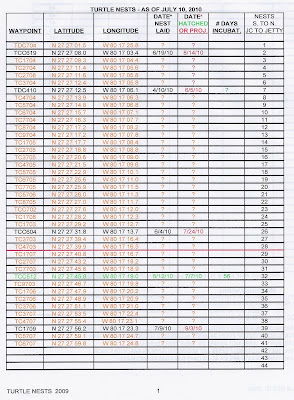
The chart looks rather "blah" this year because of the happenings discussed in the previous blog in this series. The "color-coded" chart shows: "possible remaining nests" in yellow/orange; "hatched nests" in green; "wave/storm destroyed" nests in blue and "documented remaining nests" in black. The additional color-coding was necessary this year, since it wasn't discovered until early July that EAI. Inc., the company employed to record sea turtle nests along our section of the beach, was only "staking-out" one out of each 24 nests that are laid by the turtles. That knowledge necessitated a change in the approach to our own record-keeping. Instead of relying only on EAI, Inc.'s stake-outs of nests, our "team" will attempt to go back to the beach and determine all possible nests that have been laid since March. Obviously, that is an extremely difficult task, since many/most of the traces of "sea-turtle nesting" (i.e., sea turtle tracks from the ocean to the nest and back to the ocean) have been erased/covered by beach-walker traffic, weather, and/or EAI, Inc.'s purposeful running over any tracks with their 4-wheelers to protect the location of the nests.


However, as you can see, we have given it the old "retirees' try" and have "marked" each suspected/possible sea turtle nest, on our section of the beach, on the chart that you see in this blog. To make our record more complete in the future, we will have to work in reverse once we find nests that have hatched and "project backward" our best guesstimate of the date that each next was laid. We'll use last years' "average # of days incubation" (55 days - including both Leatherback and Loggerhead nests) as a way to project when the nests may have been laid. It's not as good a procedure as we used last year but, under the circumstances, it's probably the best we can do this year.


You may be able to increase the size of the chart, for easier reading, if you double-click on the chart.

Thursday, July 8, 2010

FIRST HATCHLINGS OF THE YEAR


Finally! The first sea turtle nest (Loggerhead nest laid on 5/12/10) hatched overnight on 7/7/10! That was 56 days of incubation - somewhere in the middle of the average of 45-60 days for Loggerhead eggs. The only evidence of the hatchlings was that there were numerous little turtle tracks (mostly) heading toward the ocean. The photo included in this blog was from last year.


As was discussed in an earlier blog this year, many of nests are not "staked-out" with stakes and yellow plastic tape this year. In fact, only about 1 out of 24 are apparently are being staked-out in one section of our beach.


After talking to one of the EAI, Inc. beach patrol members, it was discovered by this writer that EAI, Inc. is in the middle of a study to compare the number of nests laid and hatched on "renourished beach" sections of the beach, versus "natural sand" sections of the beach. "Renourished beaches" are those where the Army Corps of Engineers has pumped in sand "sludge" from offshore sandbars to replenish sand that has been eroded by wave action (because of being immediately south of the jetty), as compared to "natural sand" beaches where there has not been much human intervention regarding a lesser amount of erosion of sand in those areas.


I'm not a biologist, but it would seem to me that the "research model" has several major flaws or problems associated with it as I understand the procedure. First, if you are comparing those two differing beach areas (one as the "control"), it would seem to me that you would want to have a good representative sample of both types of beach. The small section of "renourished beach" that EAI, Inc. has selected includes the area immediately south of the jetty ("replenished sand beach) where severe "escarpments" have virtually closed off the beach to any turtle access for many months. That's opposed to the other section of beach ("natural sand") that is located much further south of the jetty and had only mild escarpments, if any, for many of those months. It seems to this writer that a comparison of numbers of nests laid in each of those two sections will be flawed, since there are several major factors that are interfering with any sea turtles attempting to nest in the "renourished beach" area. It doesn't seem as though this "study" will produce valid results.


In addition, it seems self-defeating to the initial purpose of "staking-out" all sea turtle nests for identification and protection to arbitrarily decide to mark only 1 out of every 24 sea turtle nests in the remaining beach areas (those outside of the study parameters) in the section of beach that we have monitored for several years. Those "unmarked/unstaked" nests will not have any protection from beachgoers both before and during hatching, thereby making it an even longer shot that this year's hatchlings will overcome the already long odds that they have for reaching adulthood. This blogger doesn't understand the logic for those parts of the study.


Saturday, July 3, 2010


RECALCULATING! It's time to revise the game plan this year, since we have just discovered that EAI, Inc. is only marking 1 out of 24 sea turtle nests that they find on our stretch of beach this season! What? Yes - a reliable source has indicated to us that EAI is apparently doing their own research relative to sea turtle nesting on "native sands" vs. "replenished sands" on several beaches. Since the beach area that we "patrol" has had several "sand replenishments" over the last 10 years, we are apparently part of the project. I'm still not sure of their research methodology", but I plan to give EAI a call, sometime in the near future, to help clarify what is happening relative to their research.


In the meantime, it's back to square one for us, since we will need to attempt to find all of the "nesting tracks" that have occurred on our stretch of beach over the past several months. Unfortunately, it is almost an impossible task, since many of the tracks and possible nests have been obscured by weather, EAI's own buggy tracks where they attempt to cover up the sea turtle tracks, and the factor of time that has lapsed since the tracks and nests were made. It is discouraging to find out about their "research plan" at this late date, but we have nobody to blame but ourselves, since we had serious concerns about why we were not finding more EAI-marked nests way back in April. We'll just have to do our best on our own to make up for lost time! Our apologies to our "many" blog followers. We'll try to make it up to the three of you - as soon as possible!

Tuesday, June 29, 2010

A TURTLE PUZZLE

Something's wrong! We have only found 4 nests total - one Leatherback and three Loggerhead turtle nests on our stretch of beach as of the end of June this year in comparison to about 36 nests that were located and staked out by EAI by this time last year! Don't know what the explanation is. It appears that EAI is still marking all of the nests that they find, but we will need to check on that assumption.